Key Takeaways
- Sports hall and gymnasium timber floors require specialist sanding techniques that differ fundamentally from domestic floor restoration — generic methods risk premature finish failure and unsafe slip ratings.
- Granwood composition block flooring, found in thousands of UK schools built between the 1950s and 1980s, needs careful thickness assessment before sanding, as blocks may be thin, loose or moisture-damaged beneath decades of lacquer build-up.
- Court line markings must be planned into the sanding and finishing schedule — applied between seal and top coats, not painted on top of the final finish.
- Fast-curing, high-abrasion finishes such as Bona SuperSport or Junckers HP Commercial are essential for floors that endure daily PE lessons, assemblies and community lettings.
- Proper dust extraction, COSHH-compliant containment and out-of-term scheduling are critical for compliance with school health and safety requirements.
The Problem: Sports Hall Floors Take a Beating Like No Other Surface
School sports halls, community gymnasiums and leisure-centre courts take more punishment per square metre than almost any other timber floor in the country. Between indoor PE sessions, five-a-side football, badminton leagues, assemblies, school plays, exam seating, after-school clubs and weekend community lettings, these floors rarely get a rest.
The result is predictable and often alarming. Deep scuff marks from trainers that leave rubber deposits despite being marketed as non-marking. Black heel marks ground into the finish. Worn-through lacquer in high-traffic zones — particularly the centre-court circle, goal areas and the strip between changing-room doors. Faded, chipped or illegible court line markings that no longer meet Sport England design and cost guidance. In many cases, the floor has not been properly maintained in years, and caretakers resort to polish or general-purpose cleaning products that build up a cloudy, dangerously slippery residue.
For facilities managers, headteachers and parish councils across Hounslow and surrounding boroughs, the question is always the same: can this floor be saved, or does it need replacing? The answer, in the vast majority of cases, is that professional sports hall floor sanding can restore the surface to a condition that is safe, attractive and fully compliant — at a fraction of the cost of a complete re-installation.
The Agitation: Why Standard Floor Sanding Methods Fail on Sports Surfaces
A sports hall floor is not a domestic lounge. The timber species, the adhesive system, the subfloor construction, the finish specification and the usage pattern are all fundamentally different. Yet too many contractors treat every wooden floor the same way — and the results speak for themselves: premature finish failure, poor line adhesion, slippery patches under side-lighting, and floors that look tired again within eighteen months.
Granwood floors present particular challenges. These composite hardwood blocks were manufactured from compressed timber granules bound with thermosetting resin, and they behave very differently under abrasion compared with solid beech, maple or oak strip flooring. Over-aggressive sanding can expose the porous core of the block, reducing its remaining service life and making it harder for finishes to bond properly. Conversely, sanding too lightly leaves old contamination and damaged finish layers in place, compromising adhesion, appearance and slip resistance.
Then there is the question of moisture content. Many older school halls sit on ground-level concrete slabs with inadequate or degraded damp-proof membranes. If the timber is reading above acceptable levels — typically 10–12% for beech and maple species commonly used in sports flooring — applying a high-build lacquer system on top is a recipe for white blooming, delamination and costly rework. Checking and managing moisture before finishing is non-negotiable, as we explain in our guide to dust-free wood floor sanding.
Safety is another dimension that domestic projects rarely encounter at this level. A sports floor must provide consistent slip resistance across the entire playing area. Ball bounce, surface friction and shock absorption all feed into the performance criteria that govern competitive and recreational sport in schools. A floor that looks good but does not perform is a liability.
The Solution: A Specialist Sports Hall Floor Restoration Process
1. Pre-Sanding Survey and Floor Assessment
Every commercial sports floor project begins with a thorough survey. This is where the scope of work is determined and potential pitfalls are identified before a single machine is switched on. A specialist will assess block or board adhesion by tap-testing for hollow or debonded areas, measure remaining wear thickness on Granwood blocks (many are now on their second or third sand and may be approaching the limit), take moisture readings across the floor and at slab level, inspect expansion gaps, perimeter strips and threshold details, review the existing line marking layout and confirm whether it requires updating, and evaluate access, power supply and scheduling constraints such as term dates and the lettings calendar.
This information shapes the entire project specification. Without it, you are guessing — and guesswork on a 400 m² sports hall floor is expensive when it goes wrong.
2. Scheduling Around School and Community Use
One of the biggest logistical challenges with sports hall floor sanding is timing. Most UK schools prefer to schedule major floor work during the summer holiday — typically a six-week window that also has to accommodate deep cleaning, building maintenance and exam results days.
A professional team will work backwards from the required handover date, allowing sufficient time for multi-coat finishes to cure properly in summer humidity. Bona SuperSport, for example, recommends recoating within 24 hours between coats and full cure within 7 days before heavy use — though UK summer humidity (often 60–75% RH) can extend drying windows by 20–30% compared with manufacturer data recorded at 50% RH.
Pro Tip: If your hall is also used for community lettings, negotiate a two-week exclusive access period at minimum. Trying to sand around evening bookings leads to dust contamination of wet finishes and compromised results. A fortnight of uninterrupted access saves time, money and rework.
3. Machine Selection for Large-Area Commercial Sanding
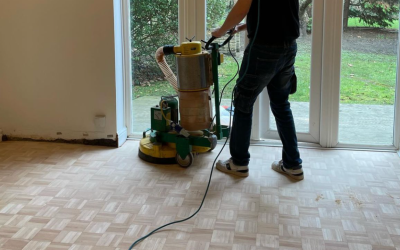
Domestic-grade sanders are not built for the demands of a 300–600 m² sports hall. Commercial sports hall floor sanding typically requires heavy-duty belt or drum sanders such as the Lagler Hummel or Bona Belt for the main field, combined with edge machines like the Bona FlexiSand for perimeter work along walls, stage fronts and fixed equipment bases.
For Granwood and composition floors, some specialists favour the Frank Spider — a wide-belt planetary machine that distributes pressure more evenly and reduces the risk of over-cutting into individual blocks. This is particularly valuable on floors where blocks have different densities or where previous sanding has already removed significant material.
Dust extraction on this scale requires industrial-grade systems. Bona DCS (Dust Care System) units or equivalent H-class extractors are connected directly to the sanding machines, capturing fine particles at source. This is not just about tidiness — it is a COSHH requirement when working in educational environments where staff and pupils will return within days of completion.
4. Grit Sequence for Sports Hall Timber
The abrasive sequence on a sports floor depends on the timber type, condition and volume of old finish to be removed. A general starting point for a heavily worn Granwood or beech floor might be:
- First cut: 40-grit or 60-grit Zirconia belt, depending on the depth of old finish build-up and the flatness of the surface
- Second cut: 80-grit Aluminium Oxide to refine the scratch pattern and level any remaining irregularities
- Third cut: 100-grit or 120-grit to achieve a smooth, uniform finish ready for sealing
- Final pass: Multi-disc or orbital finish with 120-grit or 150-grit pads for an even scratch pattern that promotes consistent finish absorption across the entire hall
Pro Tip: On Granwood specifically, avoid starting below 40-grit. The composition material can fracture or delaminate under excessively coarse abrasion, particularly on blocks that are nearing the end of their sanding life. A controlled 60-grit opening pass is often safer and more efficient than an aggressive 36-grit cut that generates excessive heat and risks block damage. Always use Zirconia abrasives for the opening passes — they cut cooler and last longer than standard Aluminium Oxide on contaminated or heavily lacquered surfaces.
5. Repairs, Re-Bonding and Gap Treatment
Once the main sanding passes are complete, the floor is inspected under rake lighting for loose blocks, open gaps, chips and surface contamination. Common repairs on sports floors include re-bonding debonded Granwood or parquet blocks with MS-polymer adhesive, replacing cracked, water-damaged or missing blocks with reclaimed matching stock, and filling fine gaps with a resin-and-sanding-dust mix for cosmetic uniformity. Where bitumen bedding residues are encountered — common in older Granwood installations — the approach mirrors our detailed process for parquet prep and adhesive removal.
6. Court Line Markings: The Detail That Matters Most
Line marking is where sports hall floor restoration diverges most sharply from domestic work. Courts for badminton, basketball, netball, five-a-side football, volleyball and sometimes tennis all need to be accurately laid out, often overlapping, in a colour-coded system that is easy to read during play.
The professional approach is to apply the base seal coat first, then mask and paint lines using specialist two-pack sports floor line paint, and finally apply the top seal coats over the lines so they are encapsulated within the finish system. This ensures durability and prevents peeling or chipping at the paint edges — a common failure point when lines are painted on top of the final coat.
Pro Tip: Always confirm the line layout, colours and widths with the school’s PE department or lettings coordinator before work begins. Regulations change, and a basketball court marked to old dimensions will not pass muster with local league officials. Getting sign-off on a drawn layout before paint goes down avoids expensive corrections.
7. Finish Systems for Sports Floors
The finish on a sports hall floor must deliver consistent slip resistance, high abrasion resistance, clarity for line visibility and manageable ongoing maintenance. Water-based polyurethane lacquers dominate the UK sports floor market for good reason — they are tough, clear, non-yellowing and compatible with line marking paints.
Popular systems include:
- Bona SuperSport: A two-component water-based lacquer designed specifically for sports floors. Excellent wear resistance, non-yellowing clarity, and full compatibility with Bona’s line marking paints. Recoatable within 24 hours; full cure 7 days under standard conditions (20°C, 50% RH).
- Junckers HP Commercial: A single-component polyurethane lacquer with high build and proven durability for multi-use halls handling everything from badminton to school assemblies.
- Loba LobaLife: A commercial-grade water-based finish with strong chemical resistance, well suited to floors that undergo regular mopping with institutional cleaning agents.
Hardwax oil is rarely appropriate for sports floors. The maintenance burden is too high for institutional settings with caretaker-led cleaning regimes, and achieving consistent slip ratings across a large playing area is more challenging than with a film-forming lacquer. For domestic and period floors where oil is the better option, we discuss the full comparison in our guide to hardwood floor refinishing.
Typically, a sports hall will receive a primer or sealer coat, followed by two to three top coats of lacquer, with light de-nibbing between coats using a 150-grit screen or abrasive pad. The total film build provides the hardness and depth needed for years of heavy institutional use.
Granwood Floors: A Uniquely British Challenge
Granwood floors are a distinctly British phenomenon. Manufactured by the Granwood company (later acquired by Junckers), these composition blocks were installed in thousands of UK schools, community halls, church halls and leisure centres from the 1950s through the 1980s. They consist of compressed hardwood granules bonded with a thermosetting resin, resulting in a dense, hard-wearing surface that was economical to install and remarkably durable.
Key points for Granwood restoration that every facilities manager should understand:
- Limited sanding life: Granwood blocks are typically 10–12 mm thick when new, but many have already been sanded once or twice over their decades of service. Below approximately 6 mm remaining thickness, the blocks lose structural integrity and should not be sanded further.
- Bitumen bedding: Many Granwood installations were laid in hot bitumen adhesive. During sanding, traces of bitumen can contaminate abrasives and migrate into the grain of the surface. A barrier primer is often advisable before the top coat system to isolate any residual contamination.
- Colour variation: Granwood blocks can vary considerably in density and colour. Sanding frequently reveals a patchwork of tones. A pigmented primer or tinted seal coat can help unify the appearance across the whole hall.
- Replacement blocks: Granwood blocks are no longer manufactured, so sourcing replacement stock for badly damaged areas usually means reclaiming blocks from floors being decommissioned elsewhere — a specialist task in itself.
Beech, Maple and Oak Sports Floors
Newer sports halls and premium facilities often feature solid beech strip, maple plank or oak boards — species chosen for their density, shock absorption and consistent grain structure. These timbers respond very well to sports hall floor sanding and can be restored multiple times over their lifespan.
Beech and maple, in particular, sand cleanly with standard Zirconia abrasives and accept water-based lacquers without the tannin pull issues that can affect oak. If the client specifies oak, tannin-blocking primers may be needed to prevent amber discolouration or bleed-through — especially when water-based finishes are applied over freshly sanded heartwood.
Water popping — the technique of dampening freshly sanded timber to raise the grain before staining — is occasionally requested on sports floors where a specific colour tone is desired. However, it adds complexity and drying time to an already tight schedule, and most institutional clients rightly prioritise speed and consistency over decorative effects.
Cost, VAT and Budget Planning for Schools
For maintained schools, academies and multi-academy trusts, budgeting for sports hall floor sanding typically falls under premises or capital improvement budgets. A few practical points worth noting:
- VAT at 20% applies to floor sanding and restoration services. Schools that are VAT-registered (most academies and MATs) can reclaim input VAT; maintained schools may need to work through the local authority’s VAT arrangements.
- Costs vary by floor area, condition and finish specification. As a rough guide, sanding and re-lacquering a 400 m² sports hall with new line markings might range from £3,000 to £6,000 plus VAT, depending on the extent of repairs, the number of finish coats and the complexity of line marking.
- Many schools combine floor restoration with other summer works to benefit from economies of scale — discuss this with your contractor during the survey stage.
Maintaining Your Sports Floor After Restoration
A properly sanded and finished sports hall floor should deliver 5–10 years of service before the next full restoration, provided maintenance is consistent. As we explain in our article on why regular floor sanding is essential for longevity, the habits between full sands make the real difference.
- Daily: Dry mop or vacuum with a soft-brush attachment to remove grit, sand and debris that act as abrasives under foot traffic
- Weekly: Damp mop with a pH-neutral cleaner approved for lacquered floors such as Bona Cleaner or Junckers SylvaClean — never general-purpose detergents
- Monthly: Inspect for scuffs, heel marks and localised high-traffic wear; spot-clean stubborn marks with manufacturer-approved solutions
- Annually: Consider a maintenance or refresh coat — a light abrade with a 150-grit screen followed by a single top coat of lacquer can extend the floor’s life significantly between full re-sands
Pro Tip: Insist on a strict “no street shoes” policy for the sports hall. Indoor non-marking trainers only. This single rule will double the life of your finish and dramatically reduce the frequency of professional intervention. Pin a laminated sign to every entrance door and brief staff, pupils and community users at the start of each term.
Frequently Asked Questions
Can all sports hall floors be sanded?
Most solid timber, beech strip and Granwood floors can be sanded, provided there is sufficient wear layer remaining and the blocks or boards are structurally sound. Sprung floors with foam-backed systems may require additional care to avoid damaging the resilient underlay. A professional survey will confirm what is achievable.
How long does the work take?
A typical 400 m² sports hall takes 5–7 working days from initial sanding to final coat application, plus additional time for line marking. Allow a further 7 days for full cure before heavy use. This fits comfortably within a standard school summer holiday window.
Will the hall smell during finishing?
Modern water-based lacquers have very low VOC emissions compared with older solvent-based systems. There will be a faint odour during application, but it dissipates quickly and does not pose a health risk when the space is ventilated appropriately.
Can you match existing line markings exactly?
Yes. Professional tradesmen work from Sport England layouts and can replicate existing colour schemes or update them to current standards. Colours, widths and court dimensions are confirmed during the survey and signed off before painting begins.
Conclusion
A worn-out sports hall floor is not just an eyesore — it is a safety concern, a compliance issue and a poor reflection on the school or facility that relies on it. Professional sports hall floor sanding transforms tired, damaged timber into a safe, attractive and long-lasting surface, without the enormous cost and disruption of a full floor replacement.
Whether your hall has Granwood blocks from the 1960s, solid beech strip from the 1990s or modern maple planks installed in the last decade, the same principles apply: assess the substrate thoroughly, select the right machines and abrasives for the material, restore the surface methodically, and protect it with a finish system that matches the demands of the space.
If you manage a school, leisure centre or community hall in Hounslow or the surrounding area and your sports floor is overdue for professional attention, get in touch with the team at floor sanding Hounslow for a no-obligation survey and specification tailored to your floor, your schedule and your budget.